How curated, role-specific reporting improves strategic focus
Company: Talboard
Modern businesses are surrounded by data. Every department generates reports, analytics, KPIs, charts, alerts, and dashboards every single day. While dashboards were originally created to simplify decision-making, many executives today face the opposite problem: dashboard overload.
Instead of clarity, they get complexity.
Instead of insight, they get noise.
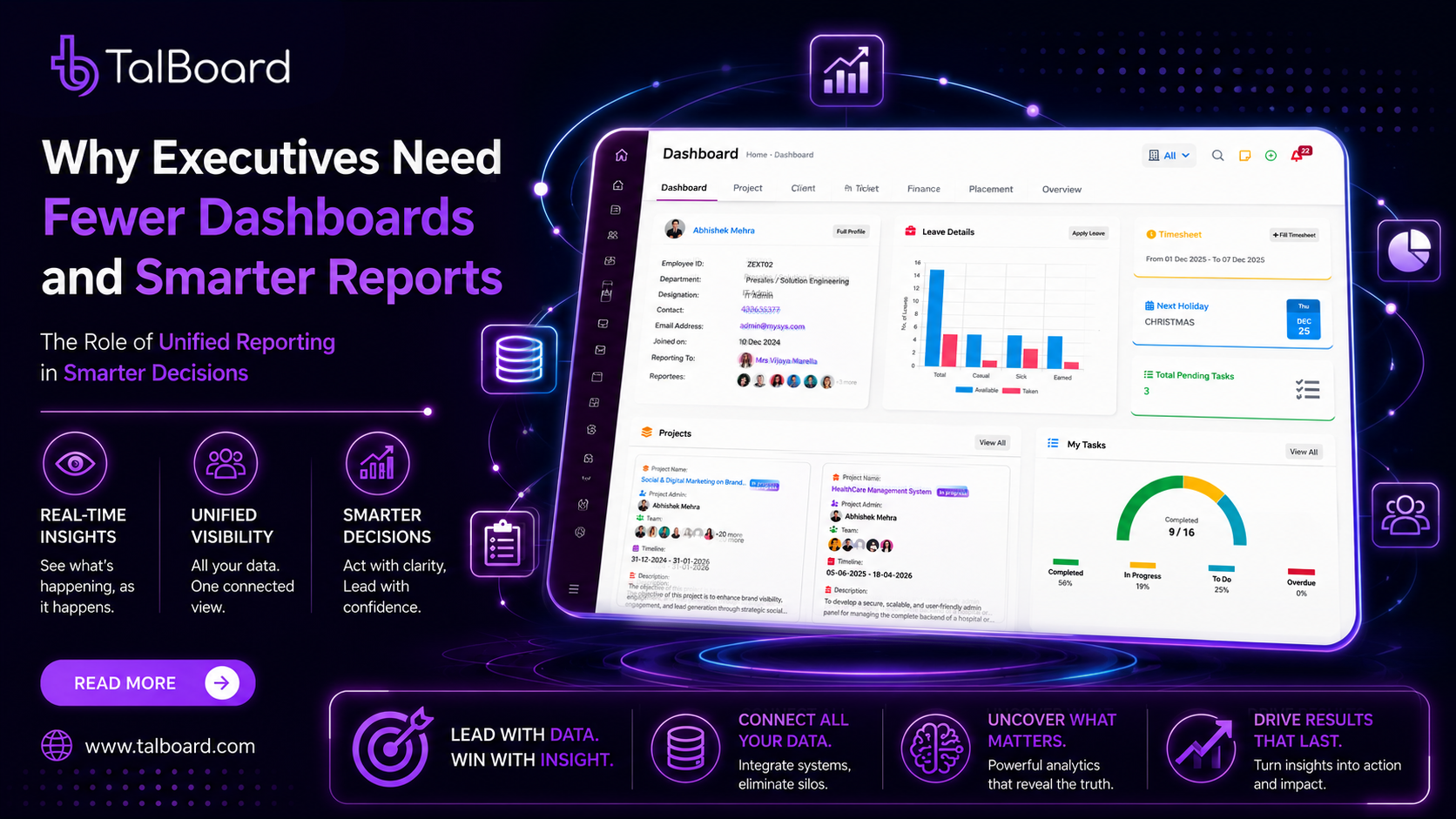
Executives do not need more dashboards. They need smarter reports that highlight the right information at the right time.
The Problem with Dashboard Overload
In many organizations, leadership teams are expected to monitor multiple dashboards across sales, finance, marketing, HR, operations, customer service, and project management.
The result?
- Too many disconnected metrics
- Conflicting data sources
- Constant switching between platforms
- Important insights buried under unnecessary details
- Slower decision-making
Executives are not analysts. Their role is to make strategic decisions quickly and confidently. When leaders spend more time searching for insights than acting on them, productivity drops and focus disappears.
Why More Data Doesn’t Mean Better Decisions
Access to data is valuable — but only when it is organized around business priorities.
A CEO may only need:
- Revenue growth
- Pipeline health
- Operational risks
- Team performance
- Strategic opportunities
But traditional dashboards often display:
- Dozens of widgets
- Granular technical metrics
- Irrelevant charts
- Department-level operational details
This creates cognitive overload. Leaders become overwhelmed, distracted, and uncertain about which numbers truly matter.
Smarter reporting is about filtering information, not increasing it.
The Shift Toward Role-Specific Reporting
The future of executive reporting is personalized intelligence.
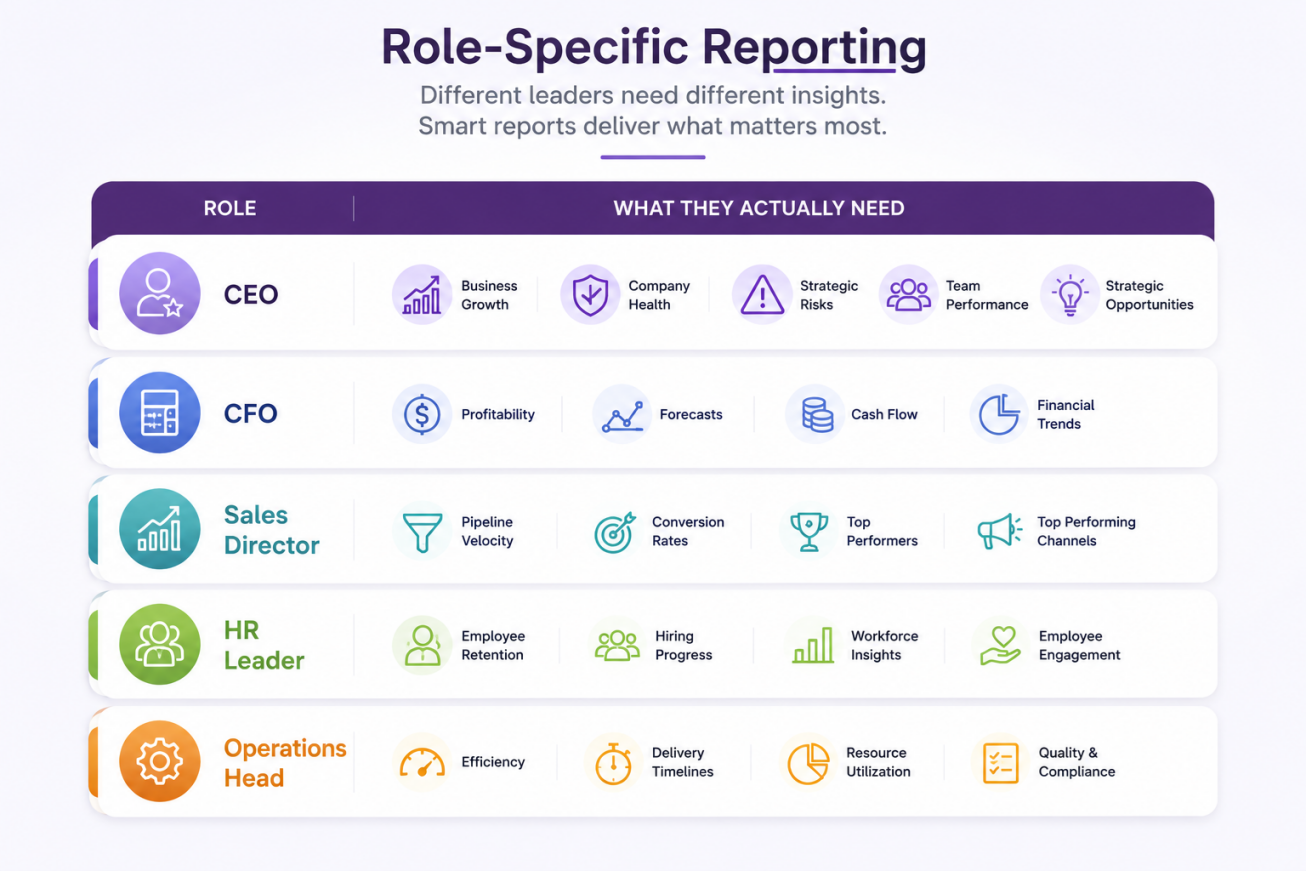
A single “one-size-fits-all” dashboard rarely works for everyone.
Instead, organizations are moving toward curated dashboards and role-specific reports that surface only the most relevant KPIs.
What Makes a Smart Executive Report?
A smart report is:
- Concise
- Prioritized
- Action-focused
- Contextual
- Easy to scan
Instead of overwhelming executives with raw data, smart reports answer key business questions immediately:
- What changed?
- Why did it change?
- What needs attention?
- What action should be taken?
The goal is not to display all available information. The goal is to support faster and better decisions.
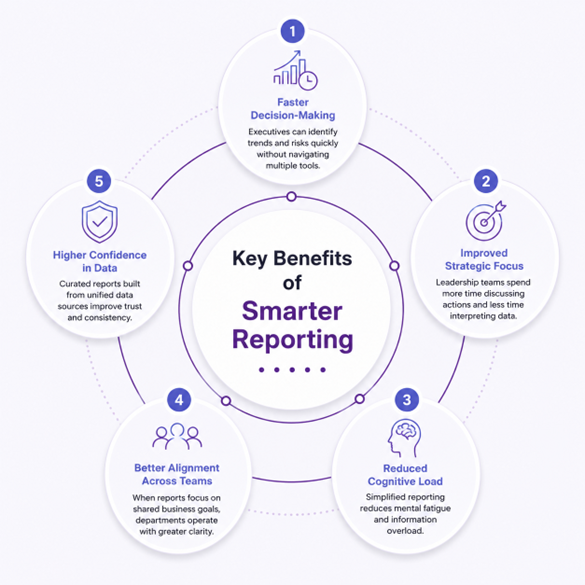
Key Benefits of Smarter Reporting
1. Faster Decision-Making
Executives can identify trends and risks quickly without navigating multiple tools.
2. Improved Strategic Focus
Leadership teams spend more time discussing actions and less time interpreting data.
3. Reduced Cognitive Load
Simplified reporting reduces mental fatigue and information overload.
4. Better Alignment Across Teams
When reports focus on shared business goals, departments operate with greater clarity.
5. Higher Confidence in Data
Curated reports built from unified data sources improve trust and consistency.
Why Unified Data Matters
One major reason dashboards become overwhelming is fragmented systems.
Data often lives across:
- CRMs
- Finance tools
- HR software
- Marketing platforms
- Spreadsheets
- Project management systems
Without integration, executives receive incomplete or inconsistent information.
Unified reporting platforms solve this problem by connecting data sources into one centralized view. This allows organizations to create accurate, reliable, and meaningful executive reports.
The Talboard Approach
At Talboard, we believe reporting should simplify leadership — not complicate it.
That’s why modern reporting solutions focus on:
- Unified analytics
- Executive-ready summaries
- Role-based dashboards
- Automated insights
- Actionable reporting workflows
Instead of forcing leaders to navigate endless dashboards, Talboard helps organizations deliver the right insights to the right people at the right time.
Final Thoughts
In today’s fast-moving business environment, executives do not need more dashboards filled with endless charts and disconnected metrics — they need clarity, focus, and actionable intelligence. Smarter reporting helps leadership teams cut through data noise by delivering curated, role-specific insights that align with strategic goals. When organizations simplify reporting and unify their data sources, decision-makers can respond faster, collaborate better, and lead with greater confidence. The future of executive reporting is not about displaying more information; it is about delivering the right information at the right moment to drive smarter business outcomes.