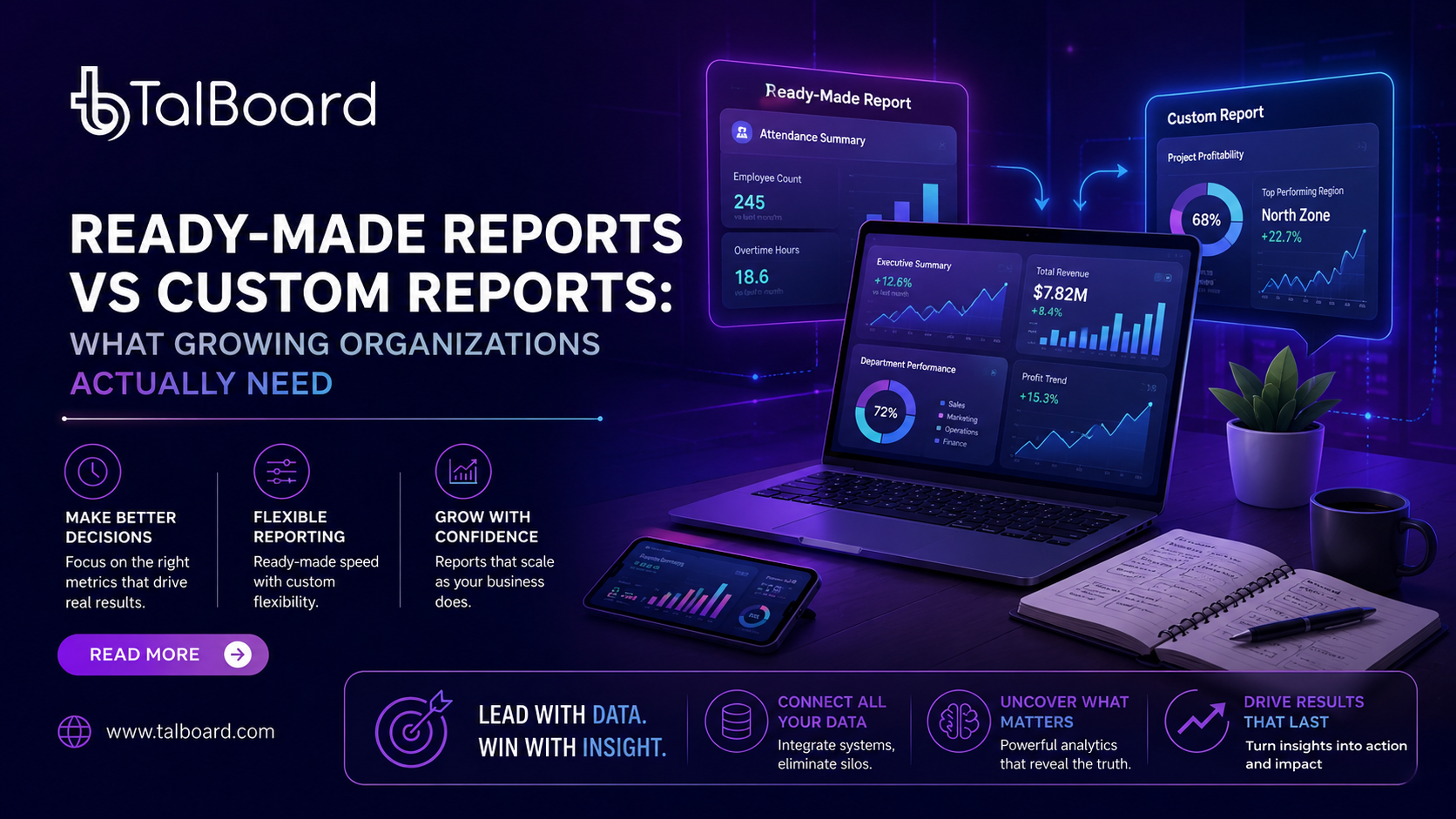
Modern organizations generate more data than ever before. Sales numbers, employee performance, payroll data, operational metrics, customer interactions, project timelines — every department depends on reports to make informed decisions.
But as businesses grow, one major question always appears:
Should you rely on ready-made reports or invest in custom reporting?
The answer is not always straightforward.
While ready-made reports offer speed and simplicity, custom reports provide flexibility and deeper business intelligence. The challenge for growing organizations is understanding when each approach makes sense — and how to avoid drowning in unnecessary dashboards and disconnected spreadsheets.
At Talboard, organizations are increasingly moving toward smarter, role-based reporting systems that combine the efficiency of prebuilt templates with the power of customization.
Why Reporting Matters More Than Ever
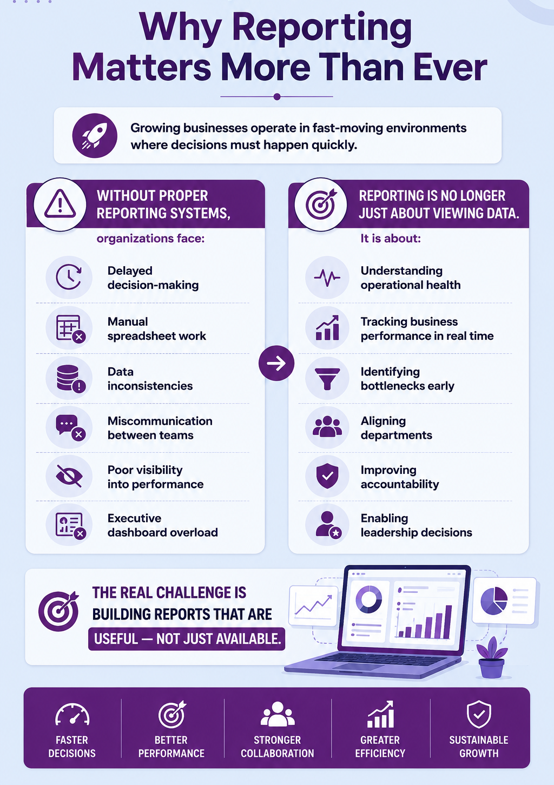
Growing businesses operate in fast-moving environments where decisions must happen quickly.
Without proper reporting systems, organizations face:
- Delayed decision-making
- Manual spreadsheet work
- Data inconsistencies
- Miscommunication between teams
- Poor visibility into performance
- Executive dashboard overload
Reporting is no longer just about viewing data.
It is about:
- Understanding operational health
- Tracking business performance in real time
- Identifying bottlenecks early
- Aligning departments
- Improving accountability
- Enabling leadership decisions
The real challenge is building reports that are useful — not just available.
What Are Ready-Made Reports?
Ready-made reports are prebuilt reporting templates designed for common business operations.
Examples include:
- Attendance summaries
- Payroll reports
- Revenue dashboards
- Expense reports
- Employee productivity tracking
- Project status reports
- Sales performance dashboards
These reports are usually included inside SaaS platforms and ERP systems.
Benefits of Ready-Made Reports
1. Faster Deployment
Organizations can start using reports immediately without spending time configuring fields, filters, or visualizations.
This is especially valuable for:
- Startups
- Small teams
- Fast-moving operations
- Businesses with limited IT resources
2. Lower Cost
Prebuilt reports reduce development and maintenance costs.
Companies avoid:
- Hiring analysts
- Building reporting infrastructure
- Creating custom integrations
- Maintaining multiple spreadsheets
3. Standardized Reporting
Ready-made reports help maintain consistency across teams.
Everyone works from the same data structure and KPIs.
4. Easier Adoption
Employees adapt faster because the reports are simple and already optimized for common workflows.
The Problem With Only Using Ready-Made Reports
As organizations scale, reporting needs become more complex.
Leadership often requires:
- Cross-department visibility
- Region-specific analytics
- Custom KPIs
- Department-specific metrics
- Predictive forecasting
- Executive summaries
- Operational benchmarking
Most ready-made reports cannot fully adapt to unique business processes.
This creates several problems.
Common Limitations
Generic Metrics
Prebuilt reports often focus on industry-standard metrics rather than company-specific goals.
Limited Flexibility
Teams may struggle to:
- Add new data sources
- Customize workflows
- Modify layouts
- Create unique calculations
Data Fragmentation
When reports cannot meet needs, teams start exporting data into spreadsheets.
This leads to:
- Duplicate reporting
- Multiple versions of truth
- Manual work
- Increased errors
Dashboard Overload
Businesses often compensate by adding more dashboards instead of improving report quality.
Executives end up viewing dozens of disconnected reports without clear insights.
What Are Custom Reports?
Custom reports are designed specifically around an organization’s workflows, KPIs, operational structure, and decision-making requirements.
These reports pull data from multiple systems and present insights tailored to different business roles.
For example:
- HR leaders may track workforce trends
- Finance teams monitor cash flow and payroll risk
- Operations managers review project efficiency
- Executives analyze company-wide performance
Custom reporting turns raw data into strategic visibility.
Benefits of Custom Reports
1. Business-Specific Insights
Custom reports align with actual organizational goals rather than generic templates.
This allows leadership to monitor:
- Operational efficiency
- Departmental productivity
- Profitability by business unit
- Resource utilization
- Employee performance trends
2. Better Decision-Making
Instead of looking through multiple dashboards, leaders receive focused reports that highlight the metrics that matter most.
This improves:
- Speed
- Accuracy
- Accountability
- Strategic planning
3. Real-Time Operational Visibility
Modern custom reporting systems integrate live business data across departments.
This eliminates:
- Delayed reporting
- Spreadsheet dependency
- Manual consolidation
4. Scalability
As organizations grow, custom reports evolve with:
- New teams
- New KPIs
- New regions
- New workflows
- New compliance requirements
The Hidden Danger: Over-Customizing Everything
Many organizations assume custom reporting means creating hundreds of unique dashboards.
That often becomes another problem.
Too much customization can lead to:
- Complex maintenance
- User confusion
- Reporting inconsistencies
- Slow adoption
- Increased operational costs
The goal is not to customize everything.
The goal is to customize strategically.
What Growing Organizations Actually Need
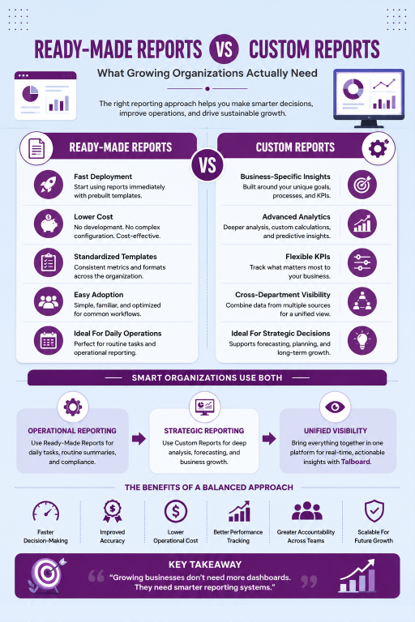
The most successful businesses use a hybrid approach.
They combine:
- Ready-made operational reports
with - Strategic custom reporting
This creates balance between efficiency and flexibility.
Best Practice Reporting Structure
Use Ready-Made Reports For:
- Daily operational tasks
- Attendance
- Payroll processing
- Expense tracking
- Routine summaries
- Compliance reporting
Use Custom Reports For:
- Executive decision-making
- Department performance
- Business forecasting
- Resource planning
- Multi-department analytics
- Strategic growth tracking
This approach reduces complexity while still delivering high-value insights.
Why Unified Reporting Matters
One of the biggest reporting problems today is disconnected systems.
HR uses one tool.
Finance uses another.
Operations use spreadsheets.
Executives rely on presentations.
The result:
- Delayed insights
- Conflicting numbers
- Endless review meetings
- Poor accountability
Unified reporting platforms solve this by centralizing operational data into one ecosystem.
This is where platforms like Talboard are transforming modern operations.
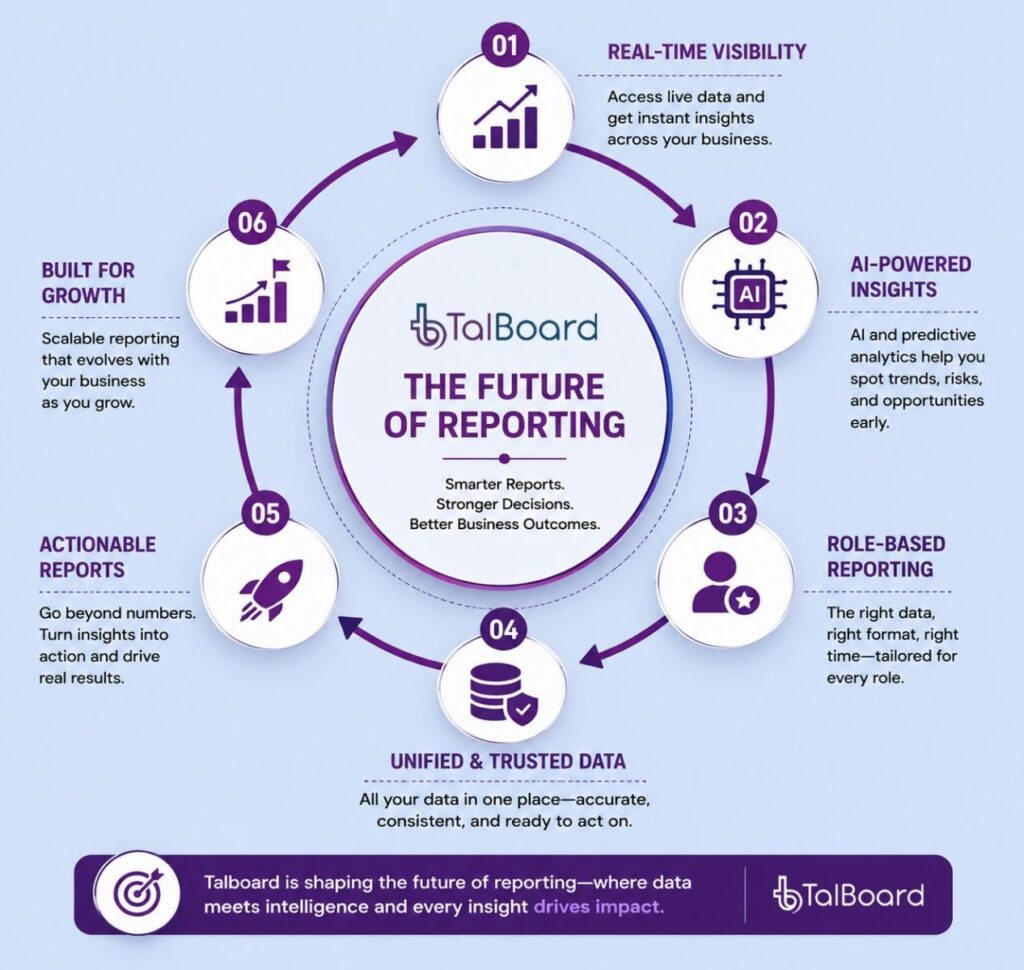
Instead of creating more dashboards, Talboard focuses on:
- Role-based reporting
- Real-time operational visibility
- Cross-department transparency
- Simplified executive reporting
- Actionable insights instead of data overload
The objective is simple:
Deliver the right information to the right people at the right time.
The Future of Reporting: Talboard
Reporting is evolving into intelligent, visually engaging infographics that simplify complex data.
Modern organizations now expect:
- Clear visual storytelling
- AI-powered data highlights
- Real-time performance snapshots
- Interactive and personalized visuals
- Predictive insights presented graphically
The future is not about creating more reports.
It is about delivering smarter, more impactful infographic experiences.
Organizations that simplify reporting while improving visibility will scale faster, operate more efficiently, and make better strategic decisions.
Final Thoughts
Ready-made reports are excellent for speed and operational consistency.
Custom reports are essential for strategic growth and business intelligence.
But growing organizations do not need endless dashboards or overcomplicated analytics systems.
They need:
- Clear visibility
- Unified data
- Actionable insights
- Role-specific reporting
- Real-time operational intelligence
The smartest businesses are not choosing between ready-made or custom reports.
They are building reporting ecosystems that combine both — intelligently.
That is the future of operational reporting.