In fast-growing businesses, one of the biggest hidden challenges is not the lack of data it’s the lack of clarity. Teams operate with different spreadsheets, disconnected software, delayed reports, and assumptions that often replace real operational visibility.
When leaders rely on outdated information or fragmented updates, decision-making becomes reactive instead of strategic. Departments begin working in silos, accountability weakens, and operational control slowly disappears.
This is where centralized reporting changes everything.
Modern business platforms like Talboard are helping organizations move from guesswork to governance by combining ready-made governance reports with customized reporting views that deliver real-time visibility, accountability, and control across the organization.
Why Businesses Struggle With Operational Visibility
Many organizations already collect huge amounts of data from HR systems, finance tools, CRMs, operations software, sales dashboards, and project management platforms.
The problem is that this data often lives in separate systems.
As a result:
- Leadership receives conflicting reports
- Teams manually create spreadsheets
- Performance tracking becomes inconsistent
- Important issues are discovered too late
- Decision-making depends on assumptions instead of facts
Without centralized reporting, organizations lose the ability to confidently answer critical questions like:
- Which department is underperforming?
- Where are operational delays happening?
- Are targets actually being achieved?
- Which teams need immediate attention?
- What risks are increasing across the business?
When reporting lacks structure, governance suffers.
What Is Centralized Reporting?
Centralized reporting is the process of bringing business data from multiple departments and systems into a single unified dashboard or reporting environment.
Instead of jumping between tools, leadership teams get one source of truth.
A centralized reporting system allows organizations to:
- Monitor business performance in real time
- Track KPIs across departments
- Standardize reporting structures
- Improve accountability
- Detect operational issues early
- Make faster strategic decisions
More importantly, centralized reporting creates organizational alignment.
Everyone works from the same numbers, same metrics, and same operational goals.
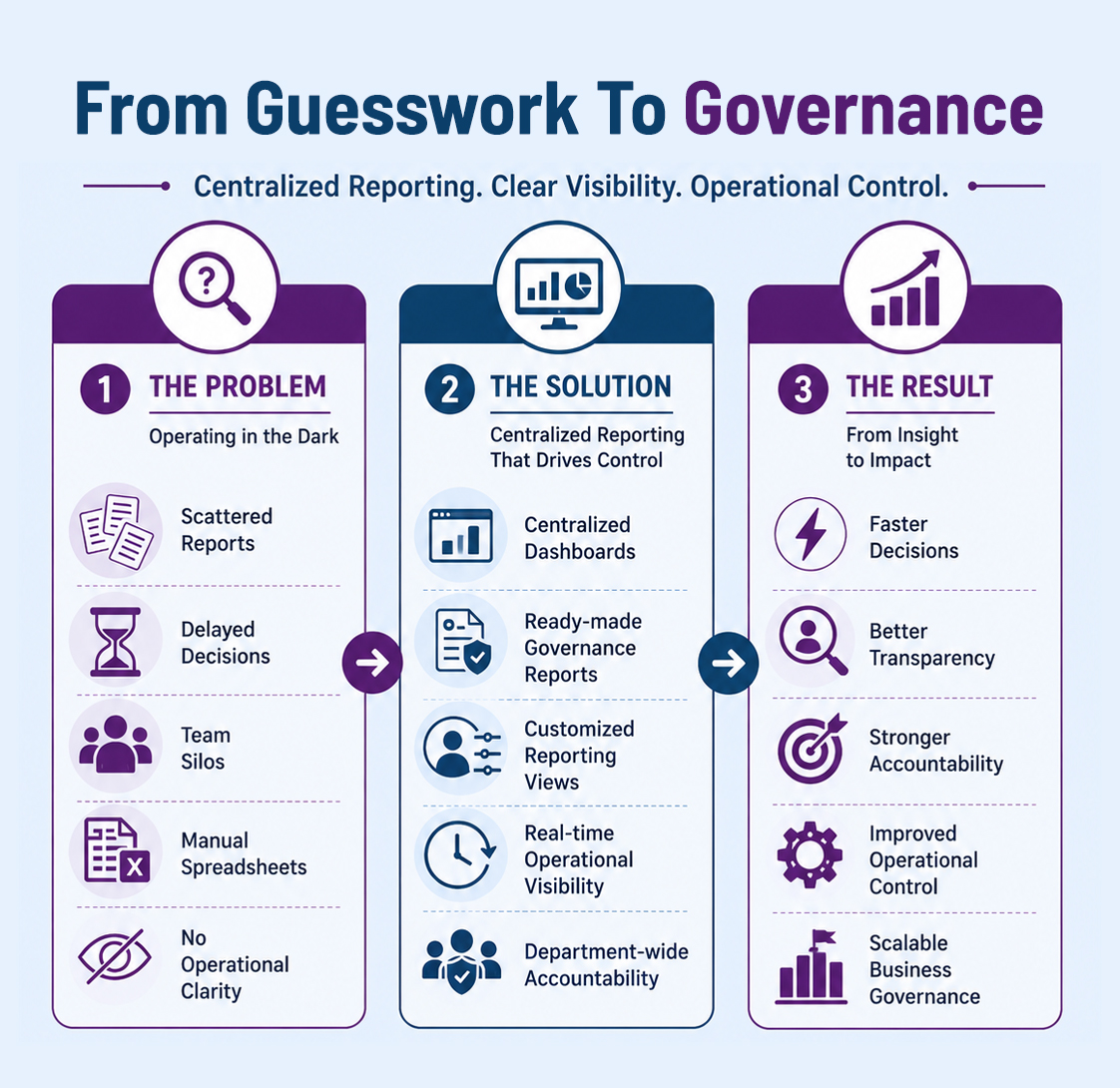
The Shift From Guesswork to Governance
Governance is not just about rules or compliance. It’s about operational transparency.
Organizations with strong governance systems:
- Know exactly what is happening across teams
- Track performance consistently
- Hold departments accountable
- Identify bottlenecks quickly
- Reduce operational blind spots
- Improve strategic planning
Centralized reporting enables this shift by replacing assumptions with measurable visibility.
Instead of asking:
“What do we think is happening?”
Leadership can now ask:
“What does the data clearly show?”
That difference transforms how businesses operate.
The Power of Ready-Made Governance Reports
One of the biggest advantages of modern reporting systems is the availability of ready-made governance reports.
These pre-built reports are designed around common business oversight requirements and provide instant visibility into operational performance.
Examples include:
Operational Performance Reports
Track productivity, pending tasks, completion rates, and department efficiency.
Financial Oversight Reports
Monitor revenue, expenses, profitability, and budget alignment.
Employee Accountability Reports
Measure attendance, workload distribution, performance, and task ownership.
Compliance & Risk Reports
Identify delays, missed deadlines, exceptions, and operational risks.
Executive Summary Dashboards
Provide leadership with high-level performance insights in a simplified format.
These reports eliminate the need to manually compile data every week or month.
Instead of spending hours building spreadsheets, leaders can focus on decision-making and strategy.
Why Customized Views Matter
While ready-made reports provide structure, every organization operates differently.
This is why customized reporting views are equally important.
Different teams require different perspectives:
- HR needs workforce insights
- Finance teams need budget visibility
- Sales teams need pipeline tracking
- Operations teams need workflow monitoring
- Executives need high-level business summaries
Customized reporting allows businesses to tailor dashboards based on roles, departments, KPIs, and operational priorities.
This flexibility creates two major benefits:
1. Better Relevance
Teams only see the metrics that matter most to them.
2. Faster Decision-Making
Users can instantly access actionable insights without filtering through irrelevant data.
When combined with centralized reporting, customized views create a balance between standard governance and operational flexibility.
How Centralized Reporting Improves Accountability
Accountability becomes difficult when information is scattered.
Teams can avoid ownership when there is no clear visibility into responsibilities, deadlines, or outcomes.
Centralized reporting solves this by creating transparent performance tracking.
Every department can clearly see:
- Assigned tasks
- Pending actions
- Performance metrics
- Delivery timelines
- Operational targets
This transparency encourages ownership because expectations become measurable and visible.
Instead of relying on verbal updates or assumptions, organizations gain data-backed accountability.
Real-Time Visibility Changes Leadership
Traditional reporting is often delayed.
By the time reports reach leadership, the problems have already grown.
Centralized reporting introduces real-time operational visibility.
This allows decision-makers to:
- Detect issues immediately
- Monitor trends continuously
- Respond faster to risks
- Optimize resources proactively
- Improve operational efficiency
Real-time governance creates agility.
Leaders no longer operate based on historical assumptions — they operate based on current business reality.
Breaking Departmental Silos
One of the biggest operational risks in growing organizations is siloed communication.
Departments work independently, data stays isolated, and collaboration weakens.
Centralized reporting creates connected visibility across the organization.
This alignment helps:
- Improve cross-functional collaboration
- Reduce duplicate work
- Increase operational consistency
- Improve communication between teams
- Create organization-wide transparency
When everyone works from the same reporting ecosystem, businesses become more coordinated and efficient.
Why Governance Matters More in Scaling Businesses
As businesses grow, complexity increases.
More employees, more workflows, more software, and more operational dependencies create greater risk.
Without centralized governance:
- Reporting becomes inconsistent
- Operational gaps increase
- Leadership visibility decreases
- Strategic decisions slow down
Scalable businesses require scalable visibility.
Centralized reporting systems provide the operational foundation needed to manage growth without losing control.
Conclusion
Operational control is no longer possible through spreadsheets, disconnected tools, or delayed reporting.
Modern organizations need centralized visibility that combines structured governance reports with flexible customized dashboards.
This combination helps businesses move:
- From assumptions to clarity
- From reactive management to proactive leadership
- From fragmented data to unified visibility
- From guesswork to governance
Platforms like Talboard help organizations create a single source of truth that improves accountability, transparency, and operational efficiency across every department.
Because in today’s business environment, visibility is no longer optional — it is the foundation of control.